There’s a version of van life that most trip photos don’t show, the one where you’ve driven four hours to a stunning coastal inlet, watched the water shimmer from your windshield, and then realized your kayak is back home in the garage because you couldn’t figure out how to bring it.
For RV and van life paddlers, kayak logistics have historically been the weak link in an otherwise perfect setup. Traditional hard shells need a roof rack, a clear height path through every gas station and garage, and a second person to lift. Leave the boat at home, and you miss the water. Bring it on the roof, and every campsite with a low clearance bar becomes a problem.
The good news: portable kayak design has come a long way. The not-so-good news: “portable kayak” now covers everything from a $200 inflatable to a $4,300 skin-on-frame, and choosing the wrong one for your travel style is a frustrating and expensive mistake.
Here’s an honest look at what’s actually worth buying for life on the road.
The Storage Reality Check
Before any recommendations, a quick grounding exercise. Grab a tape measure and check your actual available storage before reading further. The most common mistake RV and van life paddlers make is buying a kayak based on packed dimensions that sound small, then discovering the shape doesn’t fit the space they have.
A few benchmarks worth knowing:
- Most Class A and Class C motorhome rear storage bays run 36–48″ tall and 24–36″ deep. A Pakayak Bluefin in it’s rolling bag measures 43.5″ × 24″ × 16″ fits in most, standing upright.
- A standard cargo van with a raised platform bed typically has 18–24″ of clearance beneath the platform, ideal for a flat-folding kayak, not for a cylindrical nested unit.
- Toy hauler garage sections are the most forgiving, with floor-to-ceiling space often exceeding 6 feet, almost anything goes here.
- Truck beds (6.5 ft standard) can carry an assembled 10-foot kayak flat or a packed portable kayak of any type.
Shape matters as much as size. A 42″ cylindrical unit and a 33″ flat box both “fit in a vehicle”, but one slides under a bed and one doesn’t.
Nesting Kayak: The Pick for Serious Paddlers
If you paddle regularly, explore open water, or simply refuse to compromise performance for convenience, the Pakayak Bluefin delivers the best balance of portability and true hard-shell kayak performance in its category.
It solves a problem that no other kayak had solved before it: how to bring a full-length, full-performance rotomolded sea kayak on the road without a roof rack or a kayak trailer. The answer Pakayak’s engineers landed on was engineering the hull itself to nest, six rotomolded polyethylene sections collapsing concentrically into a 43.5″ rolling bag. Assemble it in under 3 minutes with no tools. Paddle a genuine 14’2″ sea/touring kayak. Pack it back up. Roll it to the car.
For a deep dive into the engineering that makes this possible, the story behind Pakayak’s patented design is worth reading before you buy.
On the water, the Bluefin is not a portable kayak that performs “pretty well.” It is a rotomolded sea kayak, the same construction, the same hull geometry, the same material underfoot that experienced paddlers know from years of conventional hard shells. Watertight bulkheads fore and aft, adjustable foot braces, padded seat, bungee rigging, rudder-ready configuration. No concessions.
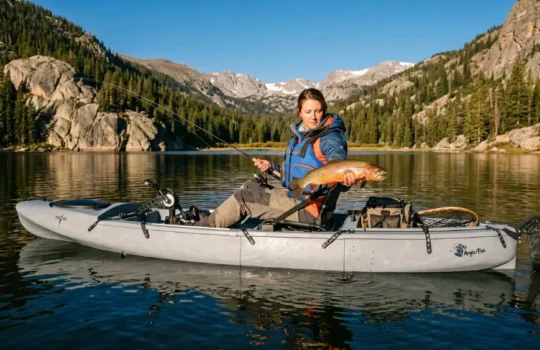
For RV travelers who also fish, the AnglerFish features the world’s first sit-on-top nesting kayak design, bringing unmatched portability without sacrificing on-water performance.
| Pakayak Bluefin | |
| Assembled length | 14’2″ |
| Packed dimensions | 42″ × 24″ × 16″ |
| Weight | 52 lbs |
| Assembly | Under 3 minutes, tool-free |
| Price | $2,195 |
| Made in | USA |
Who it’s right for: Motorhome and fifth-wheel travelers with dedicated cargo bays, van lifers with a full-length platform build, paddlers who won’t compromise on hull performance.
Who it isn’t for: Sub-compact van builds with less than 24″ of floor clearance, travelers who need to carry the kayak significant distances on foot, or those with a strict budget ceiling below $2,000.
Folding Kayak: The Weight-Conscious Choice
Folding kayaks collapse from a rigid paddling hull into a flat rectangular box, the origami approach to portability. They’re substantially lighter than nesting kayaks, pack to suitcase dimensions, and can slide into storage spaces a cylindrical packed unit simply cannot reach.
Oru Beach LT is the most practical folding pick for RV and van life use.
At 25 lbs and 33″ × 11″ × 12″ packed, it slides under most van platform beds, stands in narrow cabinet gaps, or fits horizontally across an overhead storage shelf. Setup takes 5–10 minutes once you know the fold sequence. On the water, it delivers better tracking and speed than any inflatable, genuinely enjoyable on lakes, protected bays, and calm coastal paddling.
The honest limitation: the polypropylene construction has some hull flex under load, and experienced sea kayakers will feel the difference from a rigid hard-shell. The Oru is not a compromise for casual paddlers, but for paddlers with a deep background in traditional touring, it may fall just slightly short of familiar.
For a point-by-point breakdown of where the two designs diverge, the nesting vs. folding head-to-head comparison puts every spec side by side.
| Oru Beach LT | |
| Assembled length | 12’1″ |
| Packed dimensions | 33″ × 11″ × 12″ |
| Weight | 25 lbs |
| Assembly | 5–10 minutes |
| Price | ~$899 |
Who it’s right for: Van lifers with tight builds, solo travelers doing longer portages, paddlers who prioritize weight and pack shape over paddling performance.
Inflatable Kayak: The Compact, Budget-Accessible Option
Inflatables are the most packable kayaks available, deflated, most fit into a large duffel or backpack, and even premium models rarely exceed 30 lbs. They’re the right answer for van lifers with severe space constraints, travelers who paddle infrequently, or anyone coming to kayaking for the first time and not ready to invest at the hard-shell price point.
Two tiers worth knowing:
Advanced Elements AdvancedFrame (~$700–$900) is the best performance-oriented inflatable in the accessible price range. Aluminum rib framing in the bow and stern gives it meaningfully better shape retention and tracking than basic PVC tubes. It paddles closer to a hard-shell than most inflatables, not identical, but noticeably better. Packs to roughly 25″ × 18″ × 10″ and weighs around 36 lbs with included gear. Setup is 8–12 minutes with a hand pump.
Sea Eagle 330 (~$449–$599) is the entry-level recommendation for casual paddlers and budget-conscious travelers. At 20 lbs and packing down to approximately 19″ × 13″ × 8″, it’s the smallest footprint on this list. Performance is limited to flat, protected water, it’s slow in wind and doesn’t track as cleanly as any hard-shell design. But for lake camping, calm river floats, and paddlers who just want to get out on the water a few times a season, it does the job.
| Advanced Elements AdvancedFrame | Sea Eagle 330 | |
| Assembled length | 10’5″ | 11’2″ |
| Packed size | 25″ × 18″ × 10″ | 19″ × 13″ × 8″ |
| Weight | 36 lbs | 20 lbs |
| Assembly | 8–12 min (inflate) | 8–12 min (inflate) |
| Price | ~$700–$900 | ~$449–$599 |
Who it’s right for: Tight van builds, infrequent paddlers, budget-first decisions, calm, protected water only.
Full Comparison at a Glance
| Kayak | Packed Size | Weight | Assembly | On-Water Performance | Price |
| Pakayak Bluefin | 42″ × 24″ × 16″ | 52 lbs | ~3 min | Hard-shell touring | $2,195 |
| Oru Beach LT | 33″ × 11″ × 12″ | 25 lbs | 5–10 min | Near hard-shell | ~$899 |
| Advanced Elements AdvancedFrame | 25″ × 18″ × 10″ | 36 lbs | 8–12 min | Above-average inflatable | ~$700–$900 |
| Sea Eagle 330 | 19″ × 13″ × 8″ | 20 lbs | 8–12 min | Flat water only | ~$449–$599 |
Matching the Kayak to Your Travel Setup
Class A or C motorhome with a rear storage bay: The Pakayak Bluefin is purpose-built for this situation. Wheel it to the water, assemble in 3 minutes, and paddle properly.
Airstream, fifth-wheel, or toy hauler: Any option on this list fits comfortably. Upgrade to the Pakayak if performance matters. Use the Oru or an inflatable if weight or budget is the constraint.
Cargo van or transit-style van build with a full-length platform: The Pakayak fits in most full-length van builds, standing upright or on its side in the rear. Verify your clearance dimensions against the 42″ packed height before ordering.
Sprinter or compact van with sub-20″ under-bed clearance: The Oru Beach LT at 11″ packed height is the right answer here.
Pickup truck: Most portable kayaks can ride in the bed flat. A traditional 10-foot sit-on-top also fits in a 6.5-ft truck bed if you only paddle protected flat water and don’t want to invest in a portable design.
Three Questions to Ask Before You Buy
How often will you actually paddle?
If the answer is “whenever I happen to be near good water”, which for van life often means frequently, the investment in a higher-performance option pays back quickly. If it’s “once or twice on a long trip,” a mid-range inflatable is plenty.
Will you always have vehicle-side water access?
Wheels handle most campsite-to-water carries easily. But if you’re regularly hiking to remote launch points, weight becomes the deciding variable, and the Oru or a lightweight inflatable may be the smarter choice regardless of your performance preference.
Are you paddling solo or with a partner?
Tandem inflatable options exist and pack similarly to solo models. Solo paddlers going with a hard-shell should confirm they can manage 52 lbs alone across their typical launch terrain.
Get the Kayak Out of the Garage and Into the Road
The kayak that’s always with you will always get paddled. The one at home in the garage waits for a “proper” trip that keeps getting postponed. For RV and van life travelers, the best kayak is the one that genuinely fits your rig, ships with you on every drive, and comes out every time you pass something worth paddling.
For dedicated paddlers, the Pakayak Bluefin delivers premium on-water performance with unmatched portability, while lighter and more compact kayak options are available from Oru Kayak and Advanced Elements.
Wherever your rig takes you next, bring the kayak.